Sunday, July 26, 2020

The "Epidemiologic Triangle" and Coronavirus


The epidemiologic triangle is a teaching device to help students think about the elements of infectious disease. The triangle on the left below, is the basic requirement for an epidemic. The one on the right is an example of how changing one part of the triangle can change the course of a potential epidemic and make it less likely, or at least less harmful to the populace.
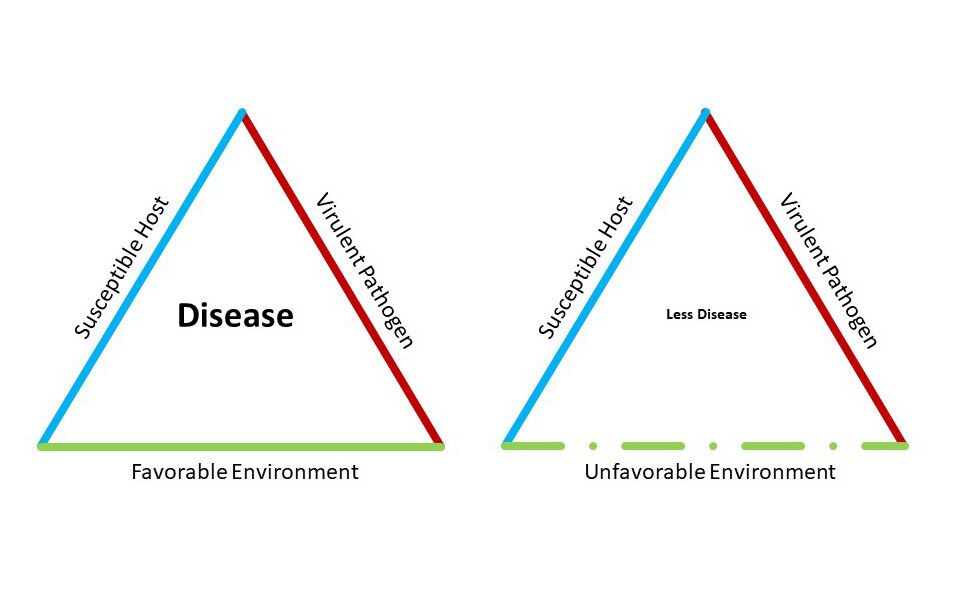
COVID-19 Coronavirus - Flattening the Curve | Disease Triangle
This image is from Popular Mechanics, a science magazine online, and in it they discuss how the use of masks, physical distancing, isolation, disinfection--all things we've been asked to do--can create a less hospitable environment for the novel coronavirus, and thus "flatten the curve." That is, reduce the number of infections enough so that things don't climb off the charts and overwhelm our medical services.

Our new friend. Artwork: Billboard.com
This is Epidemiology 101. How strong is the germ? What's it do, and whom does it do it to? What sort of environment can it do that in? This model can be abstractly applied to various other health issues, such as tobacco smoking, obesity, and so forth, but here I'm going to limit its use to our new friend The Novel Coronavirus. 
In an article on Fivethirtyeight.com, Maggie Koerth discusses how "Every Decision Is A Risk. Every Risk Is A Decision." As we now emerge from our homes, we're trying to the calculate risk of everyday activities. Koerth details how much is controversial in risk estimation, and how we're learning from the science that is still evolving. But there are things we can estimate generally. I include the link for my readers to check out, because she also writes well about how individuals engage in such calculations.

For example, being at a gathering, outdoors, with maybe eight people you know well, and it's a sunny day...even if no one's wearing a mask, the risk is probably much lower than, say, going to a bar where you're shoulder to shoulder with any number of friends and strangers. 

That's pretty straightforward, and it's intuitive. For some people, though, both prospects are equally "terrifying." What should be an easily guessed risk-difference actually has no difference to some people. Everything is equally (and possibly, maximally) risky. This is important, because as a society our own personal psychology becomes averaged into a kind of public mood. Individual estimates--whether scientifically valid or not--all go into our collective social estimation of risk, and that in turn further adjusts how we end up behaving socially. Each of us feeds that mood, and in turn the mood feeds back onto our behavior, which in turn feeds that mood and so on.

But it's not a cycle, more like a spiral. The process keeps changing with millions of individual adjustments that then alter the next moment in the cycle. This leads me to what was for me the most validating thing about Koerth's article: we're adapting. There may be a terrific vaccine around the corner. We may achieve herd immunity one day--either of these changing the host from "susceptible" to "non-susceptible." Or we may never find a decent, safe vaccine (I, for one, will not be lining up for the "first batch" of whatever soup that is--I've been personally involved in too many drug research studies!), and herd immunity may be years away.

Doesn't matter. I already see signs that people are, individually, beginning to adjust their personal risk calculus in terms that favor other things. How long can I go without visiting my elder parents? How long can my kid miss school? How long can I spin my wheels while my business withers? How long can I put off elective surgery? College? Other plans?

Eventually most of us will begin to reframe risk in broader terms that balance out other needs in our lives. This was true in the Flu Pandemic of 1918-19, and nothing about people has changed so much that this will not be the case today. It will be.

What Else Does the Triangle Tell Us?
Let me pivot to something that may give us a glimpse into this near-future: Host susceptibility. 

When I was working with HIV patients earlier in my career, it certainly looked as if that virus was really deadly. The ravages of AIDS make COVID-19 look like a wimp. Yeah, COVID kills some, but AIDS killed everybody.

Or so we thought. 

Turns out that once we had some drugs available, and we had some time to collect ourselves after losing so many bright lights (sons, daughters, Freddie Mercury, Robert Mapplethorpe, Arthur Ashe, Elizabeth Glaser...) to HIV, and after we had better technology to just understand a germ that was so much more novel than today's coronavirus, we learned that HIV was also subject to the Rule of the Triangle. HIV was not universally virulent and hosts were not universally susceptible.

It turns out that a small-ish fraction of people have genetic mutations in their immune systems that are mostly benign. These mutations may make them a little more prone to get pneumonia or the flu, but they make it really hard for HIV to get into people's immune cells. People who have both mutations (CCR5 and CXCR4) basically can't get HIV. This feature has even been turned to advantage in HIV drugs like Fuzeon. 

I began to wonder about this a few months ago. Basically the thinking has been that all humans are susceptible to COVID. This has led to the belief among many that "If I get exposed to even one viral particle I might die." This is wrong for two reasons.

First, there's dose. We don't actually know what the "dose" of virus is that can lead to a full-blown infection. This is related partly to another aspect of our triangle: virulence. Because humans (and other creatures) are equipped with protective barriers (skin, mucus, little white blood cells that live in tissues), it usually takes more than one little tiny viral particle to get infected. This is being studied, but it's early yet, so we don't have a good sense of how much or how little virus it takes to bring on disease. There are articles out there on this, but the fact is, we just really don't know yet, because there are too many factors to to make study of this easy, and because the studies themselves are very technically difficult.

Second, there's susceptibility. This is a bit easier to guess at, and with time it will become easier to know, because the same approaches we used to study HIV can give us insights into who is more, or less, susceptible to COVID.

We come into the world with trillions of T-helper cells. These cells are by dint of evolution programmed with detectors for thousands of potential infections that live on Earth. When we're exposed to one of these diseases, a subset of T-cells programmed with that pattern begins to genetically transform themselves into even better detectors for that infection that then go after the infection with a vengeance. This is why it takes 7-10 days to get over a cold: it took your T-cells that long to read the new cold virus (they change often), make genetic adjustments, and then to bring in the rest of the players that come rushing in to rid the body of the infection. 

Lymphocytes - Cell CartoonsCould it be that some of us are just better genetically equipped than others to resist cornonavirus? I found an article recently that suggested that this is the case. I include a link here because readers might find it as interesting as I did. It basically reminded me that Nature works in mysterious ways...but it still adheres to rules. In this not-yet-peer reviewed article from a research team in Sweden, we learn that maybe antibodies--whether from prior infection or a vaccine we have yet to invent--may be less important than something we're already carrying around inside us, the valiant T-cell! 

Maybe some will find this reassuring. I do. In the flurry of "information" flooding our TVs, radios, Facebook feeds, and phones, I find it comforting to know that Nature still follows rules, and if we pay attention to those rules, perhaps we'll be able to better understand and apply our own personal risk calculations with less anxiety.

As always,
Be well!

Friday, July 17, 2020

Here it comes...COVID and Schools

Photo: Aha!parenting.com

Well I spent my first day back in the hospital last week, and actually felt pretty safe. Kudos to the Hershey Medical Center for their engineering and environmental controls on COVID spread! And I feel fine--so far, so good. And the students were delighted to be back, even if they were a bit anxious about their skills and knowledge being "rusty." They performed wonderfully.

So there's been some other school stuff in the news this week, as the country's K-12 schools struggle with decisions on when, how, and if they'll re-open. The White House says all schools must reopen fully for in-person instruction in the fall. In interviews on NPR and elsewhere, I haven't heard a single K-12 teacher or union representative say anything other than they don't feel safe to go back to in-person teaching. Some school administrators seem to be putting a hopeful and optimistic face on things, but they admit that there are challenges that include inadequate classroom space for social distancing, the difficulty of policing mask use indoors among very young children, and the costs and time needed to continually disinfect surfaces and equipment.

It would seem that the most common-sense thing to do is simply continue instruction at a distance, using online learning. Why go back at all?

There's the rub.

I myself teach, and I can tell you: online teaching? It depends. I've seen good results from well-designed, sort of "self-study" systems that students do in a guided way on their own, so-called "asynchronus" (at any time) learning. The student isn't "in" a classroom--virtual or otherwise, and studies in a guided way, often interacting in "discussion boards". This is the basis of outfits like University of Phoenix, or Penn State's own World Campus. I feel that this is a good approach for upper division college and graduate students.

"Residence instruction" is the college term for sitting in a classroom or lab. A report by the Department of Education over a decade ago, however, found that neither residence instruction or online learning was as effective as a combination of the two. You take the strengths of one and the strengths of the other and create a "hybrid" experience. I taught this way a lot up until about 2018.

What I experienced in the spring of 2020 wasn't very good at all. It was like the worst of both worlds, at least if the looks on students' faces, the lack of active discussion or questions from students, and the general feedback suggests.

There were some things we designed for our nursing students that were better online. Things like professionally-designed patient care simulations that keep score--the students liked that. They reported that some "virtual clinical" experiences were actually better than some of the observational experiences they'd engaged in prior to the shutdown. Instead of being passive observers of nurses at work, they became active participants in learning that was designed to hit certain key objectives.

There were some things that were worse. Isolated from each other most of the time, that isolation seemed to carry through to the Zoom-classroom experience. Instead of excited chit-chat before and after class, or sudden shares of their own experiences in class, they were mostly silent.

And nursing students not in a hospital seeing real patients? Not only is it counterintuitive (would you want to be cared for by a new nurse who has only ever seen "patients" as robot avatars on a screen? I wouldn't), the students know they haven't been getting the experience they will need in their careers. The feedback I got this week was overwhelmingly gratitude from the students who now have an opportunity to get back into the hospital and see real patients.

I can only guess how this went for K-12 education. From what I've heard, students learned little. And the isolation in those age groups reportedly causes learning delays and mental health problems.

We are a social species, after all.

But one can argue "Well, we had to cobble that together in literally two weeks. We were doing the best we could. We can do better in the fall after we have had time to prepare over the summer." I'm sure that's somewhat true. I know I am planning improvements. (Even though I will be on campus this fall, due to room size and social distancing requirements, every class will have at least some students sitting in front of their screens.)

Sure. It'll be great. Or will it?

The American Academy of Pediatrics has warned that schooling online in isolated settings is likely to cause real harm to the learning and development of the current generation. Less-discussed is their warning that adequate safety procedures and controls need to be in place to assure a safe return to in-class learning.

Charter schools have been doing learn-at-home for maybe 20 years. Many kids get home-schooled by parents and people in their circle of family and friends. The sky hasn't fallen. Although I should mention that most of these cyberschools have extensive experience and have taken the time to address issues of social development and internet access. For example, kids in cyberschools can still participate in local school sports programs. Home schoolers often join co-ops that help facilitate field trips, social activities, and group schooling among home-schooled kids in the same locality.

Will that be possible in just another 5 or 6 weeks as some districts open up?

Parents are split. Having had the spring 2020 experience, many find that there's a reason we have schools and teachers. It works better! Moreover, many parents face choosing between work and looking after their kids who can't go into school. Some families have vulnerable persons in the home, and with their kids in schools with lots of other kids, it's feared that COVID will get passed around to these people.

Teachers seem mostly anxious, anxious that they'll get sick, anxious that the kids will get sick, anxious that the spring 2020 approach isn't working well. But I haven't heard very much about how they plan to improve upon the home teaching experience--in short there's very little enthusiasm for any outcome. They often cite a lack of material support from school districts, and that requires money, and that requires taxes, and tax revenues are way down because of COVID.

And don't even get me started about lack of internet access. I've seen students using their phones as learning platforms. I've heard of people parking all day by McDonald's because their home internet is too slow for Zoom or other class activities (video, learning games, homework completion). Cyber schools make sure their students can access the needed technology, and it may be included in the tuition. But that's not factored into regular districts' budgets--despite scenes this past spring of some districts handing out iPads and Chromebooks to families waiting in line in their cars. A loaner laptop is great--but what if you have dial-up internet?

I don't have answers to these problems. I'm writing this because children's school experience is deeply and profoundly formative, and so I see serious learning and developmental problems ahead if we don't start having less polarized, more productive discussions about this problem. Most of what I hear on the radio or read online in articles or see on TV are really dysfunctional discussions that seem to "spin" concerns toward one outcome or the other.

It's impossible to have it one way. It will not be possible to guarantee that coronavirus will not be spread, no matter what schools do. The novel coronavirus is going to be with us for some time. People are going to die regardless. A vaccine is not "right around the corner," even if many scientists are working on it, and even if some reports suggest a vaccine is possible. Our society was not prepared for this, and no matter how ardently people argue for masks or how much hand sanitizer we use, this isn't over. We cannot keep our kids at home forever--it'll stunt their growth and development.

We can't have business as usual. We can't remain isolated indefinitely.

So we better start having better discussions about how we can all come through this healthier.


Monday, July 6, 2020

Life in the COVID Lane

The moment has come. This is the time when we emerge from our lockdowns, blinking our eyes in the sunlight as we adjust to three months hiding out in our houses (well, I wasn't "hiding out" but many have been). 

Image: Nurse.org

Now in some places, coronavirus cases are down, and in others, cases are up, and there's the sense that we're far from the "other side" of the COVID-19 pandemic. Businesses are reopening, others are having to re-close. Students who spent the latter half of spring term zoning out in front of Zoom classes are soon to return. My own students, who had to settle for seeing virtual patients--basically speech generating avatars--on screen, are keen to get back to seeing real patients with real problems. 

And believe it or not, hospitals are keen to have them back! After all, our students represent their future success. I predict a lot of doctors and nurses are going to retire early, having put in their time in the trenches against the virus since February. I'm already starting to see this, and I wish them well. Having myself spent a bit of time in facilities seeing patients in PPE in this pandemic, I can understand that some folks have put in a lot of hard work and deserve a long rest.

On Facebook and elsewhere I see vituperative, sometimes nasty exchanges about the tension between coming out of our caves to carry on, and staying locked in until all danger has passed. I guess I shouldn't be surprised by the split, but I am a bit disappointed by how strongly (and often meanly) people on either side of this split are with each other. I kind of had to stop following Facebook. 

Here are some of the issues working against staying locked in, and "safe."
  • Young students are displaying abnormal adjustment behaviors and early mental health problems related to isolation from peers. They are falling behind in their learning in ways that may be difficult to remedy. 
  • Older persons, especially in nursing homes, are showing signs that the isolation is wearing them down. Their mental and physical health is deteriorating. I've seen this up close in my practice. 
  • I've seen people putting off getting health problems checked out, sometimes with tragic results, because they're afraid to go to hospitals and some doctors' offices are not yet open or only doing telehealth.
  • My nursing students--and health care students elsewhere--want to see patients, learn their craft, and are often being told they cannot by colleges whose faculty fear getting sick, while the hospitals are desperate for new workers to replace those they'll lose. 
  • More and more people are becoming hungry and homeless due to prolonged shutdowns. The economic harm from our neglect to plan for such a pandemic will probably last for years.
  • I see more and more people unwilling or unable to move themselves from a position of safe isolation to more engagement as they become swallowed up by their anxiety. What will happen to them, safe, but alone and isolated?
I don't have easy answers to these problems. On the one hand, we don't want people getting sick and maybe dying. On the other hand, how far can America decline without some things moving forward? We're kind of stuck.

I've talked to people who say they aren't coming out until there's a vaccine. But there's no certainty we'll ever have an effective vaccine, but if we get one, it's going to be a while. A year is optimistic, because even if one or more vaccines are developed, it will still take time to get it out to people. So here too, they're kind of stuck.

Contact tracing and selective quarantine of infected persons can help, but we have no national strategy for effecting such a plan. States and localities are basically on their own. Some of their plans are working, others, not so much. States open up, others shut down again. Stuck.

So maybe life in the COVID lane right now is just that: "stuck." Can't go forward. Can't go back. 

I have been asked to come back this summer to teach clinical students in the hospital, because we have too many faculty who aren't willing to get back in there, because we all know there's COVID in there. I know it could walk into my office too, but I have kept seeing patients because sometimes "telehealth" just doesn't get the job done. You can't listen to someone's lungs on Zoom. You can't stitch up a wound on Skype. In that vein, I will be going into the classroom this fall as well. I can't teach someone else how to listen to someone's lung on Zoom either. 

Maybe I'm being foolish. Maybe I should stay home.

But I look at it this way: If my work isn't important enough to risk my health and life for, then what is? Why am I even doing this?

Some people may lead lives that will never require such a thing of them, and that is comforting. That is not my life, and so I go into the breech.

Wish me luck!